Concrete Contractor in Mount Vernon, NY
Concrete work in Mount Vernon runs on the City's own code, not on Yonkers' rules. Under section 102-3A, an Office of Code Enforcement Officer made up of the City's Building Department and Fire Department enforces the New York State Uniform Code. Under section 227-10A, the Commissioner of Public Works issues the written permits for sidewalks, driveways and lowered curbs in a public street. We pour and replace driveways, aprons, sidewalks, front steps and walls on Mount Vernon lots. Each written quote we send names the City permits involved and what the price includes, and the price is settled before any slab is broken.
Mount Vernon meets Yonkers at the Bronx River: Charter section 3 runs Mount Vernon's west line along the river's center line, and the City of Yonkers Charter, section C1-2, bounds Yonkers on the east by its middle line. Section 3 also carries Mount Vernon's south line along the northerly boundary of the City of New York. Census Bureau QuickFacts gives the city a 2020 Census population of 73,893 and a 2020 land area of 4.39, counted in square miles. The American Community Survey for 2020-2024 puts its owner-occupied housing unit rate at 42.9%.
a free written quote that names the permits the job needs.
Free quote
Mount Vernon's street code: sidewalks, aprons and lowered curbs
Upkeep of a Mount Vernon sidewalk falls on the property beside it. Section 227-56 of the Mount Vernon code tells every "owner or lessee" of premises abutting a street to keep the contiguous walk clear of dirt, weeds and obstructions, to maintain it "in good condition," and to "perform all repairs necessary thereto." The same section allows 12 hours after a snowfall has ceased, or ice has formed, to clear it. For trip hazards and roots, see sidewalk repair and replacement.
Work in the street needs the Commissioner's written permit first. Section 227-10A requires one before anyone constructs, removes, replaces or repairs a sidewalk or driveway, or lowers a curb, within a public street (section 227-1A names the Commissioner of Public Works). The permit is "valid for an effective period not to exceed 30 consecutive calendar days" (section 227-10B), and an extension must be asked for in writing before it lapses. Section 227-12A sets walks at "not less than five inches" of a "one-to-two-to-four mix" over tamped steam cinders, and section 227-12B sets driveways at six inches of concrete with "one-fourth inch round rods."
Section 227-12C writes air into the mix: "All concrete for curbs and sidewalks shall be air entrained (four-percent to six-percent air in concrete)," entrained air being microscopic bubbles that relieve the pressure of water freezing inside the slab. On the State side, the Department of State's bulletin TB-1009-RCNYS assigns the whole State to the "Severe" weathering class, and the model code's 2009 IRC Table R402.2, as Penn State reproduces it, gives steps and porches exposed to the weather 3,500 psi for severe weathering; our weather, ground and code data page has the rest.
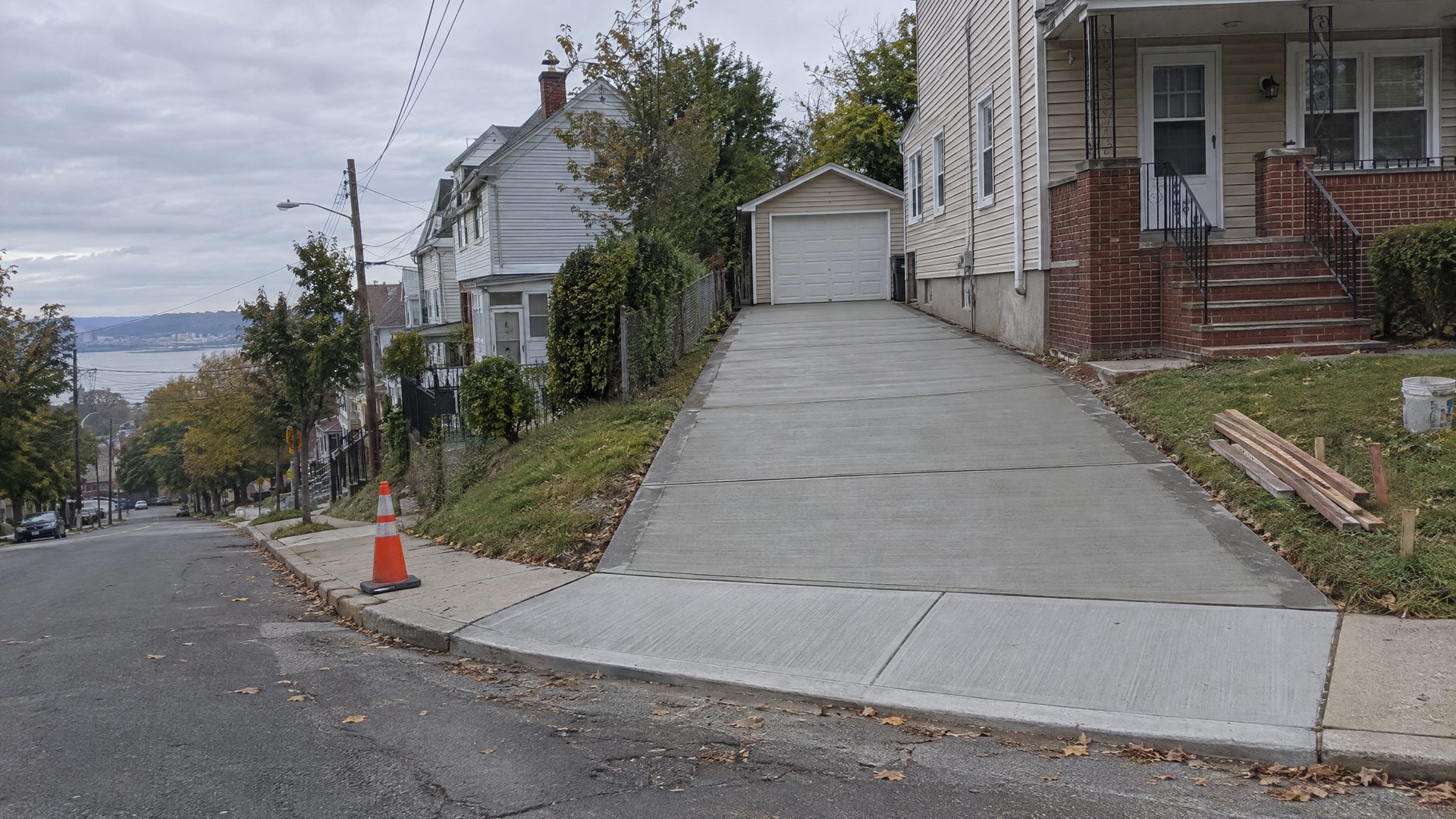
A lowered curb, the dropped stretch a car crosses into a driveway, has firm limits in Mount Vernon's curb-lowering code. Without prior written approval from the City Council, section 227-13A bars the Commissioner from allowing one longer than 18 lineal feet in front of a lot, and section 227-13B allows only one per improved tax lot. Under section 227-13D the applicant files three detailed sketches and pays the City Clerk "a fee of $10" per linear foot lowered, a line last amended 11-12-2025. Section 227-13G surfaces the apron, the stretch from curb to property line, with "reinforced concrete six inches in thickness" or with at least two inches of bituminous surfacing over four inches of crushed stone; our driveway apron and curb cut page covers the build.
See Mount Vernon, NY on Google Maps — we work there from Yonkers.
Building permits, plot plans and Mount Vernon's review board
Mount Vernon's Chapter 102, whose first article was adopted 9-25-2024 by L.L. No. 6-2024, requires a building permit "for any work that must conform to the Uniform Code and/or the Energy Code" (section 102-4A). Section 102-4C exempts six categories, sheds and playhouses up to 144 square feet among them; fences, retaining walls, driveways, sidewalks and patios are not on the list. Section 102-4B(2) of the building code asks for a topographical survey plot plan for "site work, retaining walls and driveways," showing the "Driveway profile from the center line of the street to garage floor or parking space." Fees are set by City Council resolution under section 102-18; we could not find the schedule.
Walls and ramps also go before the Architectural Review Board, whose certificate of appropriateness section 10-5D(1) requires for "proposed fences, proposed retaining walls, proposed freestanding walls, proposed ramps" before a building permit issues. Chapter 148 bars anyone from performing a home improvement contract without a City license, and section 148-3 counts driveways, terraces and patios as home improvements; Westchester County's Department of Consumer Protection adds its own advice: confirm the license, then search for judgments or liens filed against the business. Heights and footings for a wall on a sloped yard are on our retaining walls page.
- Front yards, section 267-14B(1)(a): wrought iron or aluminum fences and masonry walls of at least 25% open construction up to four feet high; solid masonry walls no higher than three feet.
- Side and rear yards, section 267-14B(1)(b): fences and masonry walls up to six feet, or eight feet for a fence at least 75% open where the lot exceeds 7,000 square feet and 75 feet of frontage.
- Section 267-13A(1) lets decks and terraces no more than 18 inches above the ground stand in required yards, and permits ground floor steps and entrance porches there.
- Trees: private trees under 10 inches DBH (trunk diameter at breast height) are exempt; other removals need a Department of Public Works application, at $50 per tree under section 252-5A as amended 12-14-2022.
Two rivers, one schist reading and the landmarks around Mount Vernon's streets
Mount Vernon sits between the Bronx River on its west line and the Hutchinson River on its east, in the County's 2021 hazard plan. County Parks lists a one-mile Bronx River Reservation loop "near Oak Street in Mount Vernon" and says Willson's Woods Park "was acquired in 1924." At Saint Paul's Church National Historic Site, in the city, the National Park Service writes that "Since 1665, Saint Paul's Church played a vital role in the colonial life of Eastchester." Metro-North stops at Mt. Vernon West, a Harlem line station the MTA lists as accessible by elevator, and at Mt. Vernon East on the New Haven line.
Our files on Mount Vernon's ground are thin. At one point sampled just east of the Yonkers line, the University of Wisconsin-Madison's Macrostrat map service returns the Manhattan Formation, pelitic schists and amphibolite; we hold no soil survey or year-built count for the city. Chapter 226, the stormwater law, starts at one acre of disturbance, so a single driveway or patio normally sits below it. TB-1009-RCNYS has each jurisdiction set its own frost line, the minimum footing depth under finish grade; Mount Vernon's figure is not in our facts. Before any excavation we place an 811 locate request with UDig NY, the notice 16 NYCRR Part 753 calls for.
Concrete Work We Do in Mount Vernon
Each of these jobs is available in Mount Vernon, and our written quote names the permits Mount Vernon requires:
See the full pricing guide for typical ranges.
Mount Vernon FAQs
What is the longest curb cut Mount Vernon allows?
Eighteen lineal feet in front of a lot, unless the City Council approves more in writing beforehand, under section 227-13A of the Mount Vernon code. Section 227-13B allows one curb lowering per improved tax lot, and section 227-13D charges $10 per linear foot of curb lowered, paid to the City Clerk with three detailed sketches.
How soon must snow be cleared from a Mount Vernon sidewalk?
Twelve hours. Section 227-56 gives whoever owns or leases premises along a street 12 hours, counted from when the snowfall has ceased or the ice has formed, to clear the adjoining sidewalk of snow and ice. We ask that a walk we pour go through its first winter without deicing salt.
Is a new concrete driveway in Mount Vernon subject to sales tax?
New York's tax documents put a newly installed driveway on the capital-improvement side, untaxed, and replacing sections of one on the taxable-repair side. That split is printed in the State tax department's Publication 862, and Tax Bulletin TB-ST-104 has the owner of a qualifying job sign Form ST-124. Publication 718 lists Mount Vernon at 8-3/8 percent. Our written quote shows whether a tax line applies; our concrete cost page collects published prices.
Does Mount Vernon follow New York City's sidewalk rules?
No. Mount Vernon is a Westchester County city with its own Charter, and section 102-3A has its Code Enforcement Officer enforce the New York State Uniform Code. Its sidewalks, curbs and aprons follow Mount Vernon's City code, sections 227-10A through 227-56, with permits from its own Commissioner of Public Works. The City of New York starts at the south line Charter section 3 draws.
Get Your Free Mount Vernon Quote
Free quote