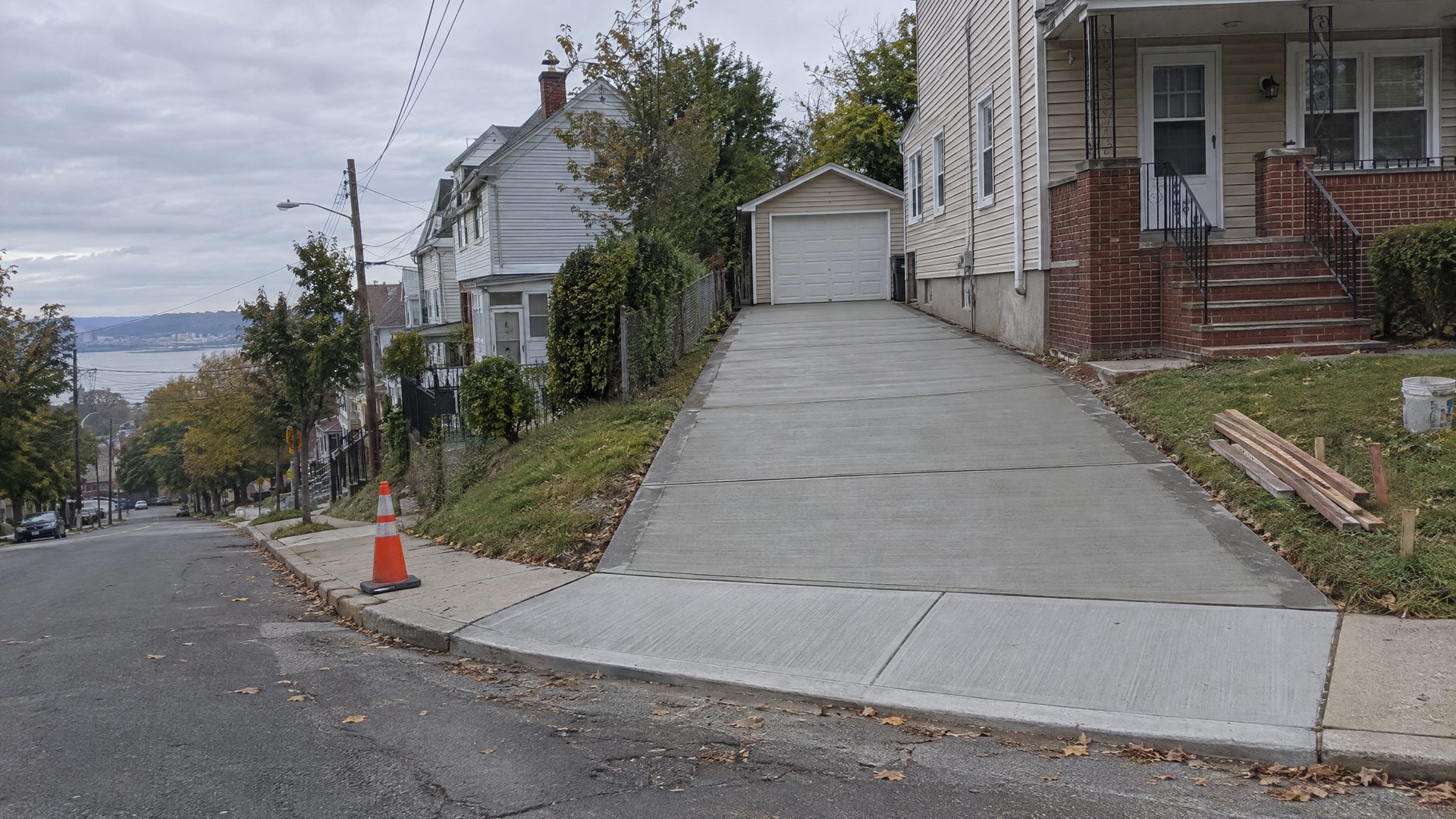
Yonkers is an old, built-out city. Census Bureau estimates from the American Community Survey, 2024 5-year release, count 85,006 housing units here and date 22,653 of them to 1939 or earlier; the median year built is 1958 in Yonkers and 1959 in both Westchester County and New York State. The City's 2000 Comprehensive Plan puts it plainly: "By 1977, Yonkers was virtually built-up; very few sites remained for development." The same survey counts 21,030 one-unit detached houses and 22,278 of the city's housing units in buildings of 50 or more units. A new stoop, walk or apron here is poured against foundations, stone walls, curbs and lot lines that already exist.
The ground is steep in places and often rocky. The City's 2000 Comprehensive Plan describes 4.5 miles of Hudson River waterfront and extremely steep slopes on City-owned land in the north. USDA Natural Resources Conservation Service soil maps, sampled at points across the city, show urban land mixed with Paxton soils on 8 to 15 percent slopes and with Charlton-Chatfield soils in a unit mapped as "hilly, very rocky"; NRCS gives Chatfield soils a depth to bedrock of 50 to 100 cm, and the U.S. Geological Survey maps that rock as Fordham Gneiss at most points sampled. The Saw Mill River, buried in the 1920s for flood mitigation according to the EPA, has been daylighted through downtown in phases with State grants. Our Yonkers weather and ground data lists each source.
Winter sets the pouring calendar. NOAA's 1991-2020 normals, taken at the Dobbs Ferry-Ardsley station, show lows at or below 32 degrees F on 108.9 days a year and highs that stay at or below it on 13.8, and put the annual snowfall, in inches, at 32.7. NOAA's median freeze dates there are April 20 for spring's last 32-degree reading and October 26 for fall's first. The months between are the late fall, winter and early spring that NRMCA's CIP 2 flags for outdoor pours, when concrete can freeze while still saturated. NOAA's normals for Central Park, in New York City south of Yonkers, put the yearly count of freezing lows at 67.3, so a Yonkers schedule follows the colder Westchester record.
Salt is the other half of a Yonkers winter. The City maintains 654 lane miles of roads, and its Department of Public Works' Street Maintenance Division plows and salts them, laying salt at "at least 300 pounds per lane mile" from a barn that holds 7,500 tons; the City's snow page names salt and brine only. NRMCA's CIP 2 accepts rock salt and calcium chloride for concrete, lists heavy deicer use on new, still-saturated concrete among the causes of scaling, and warns off magnesium-based salts, ammonium nitrate and ammonium sulfate altogether. The American Concrete Institute adds that some deicing salts form calcium oxychloride in the cement paste at joints. That is why our outdoor concrete carries entrained air.
Sidewalks are the owner's job in Yonkers. Section 103-1, in Chapter 103 of the City code, Streets and Sidewalks, puts the duty on the owner of each lot. The City's page on property owner responsibilities puts possible fines at $250 to $5,000 for a walk left in disrepair, and it requires an Engineering Department permit before any sidewalk repair or replacement. Snow falls to the owner too: section 103-9 requires snow and ice cleared for the sidewalk's whole width within six hours after a daytime snowfall ends, and before 12:00 noon the day after one that falls at night. Throwing that snow into the street is unlawful under the same section, and section 103-8 adds a three-foot clear area around fire hydrants.
Yonkers is its own city, not part of New York City. Section C1-2 of the City Charter bounds it southerly by the City of New York, northerly by the Town of Greenburgh and easterly by the middle line of the Bronx River; Mount Vernon, Bronxville and Tuckahoe lie on the river's far bank. The City says its Department of Housing and Buildings enforces the Yonkers Zoning Ordinance, the City's municipal codes and the Codes of New York State, so New York City sidewalk and building rules have no force here. Each neighbor keeps its own building department, as Westchester County's list of local building departments shows, and our quote names the permit the job's address calls for.